Tuesday, March 25, 2014

Blogging toward Sunday

"Healing of the Blind Man" by Buoninsegna via Wikimedia Commons
In preparation for worship this Sunday read John 9:1-41. Afterward reflect on the following:
  1. How does Jesus go about healing the blind man?
  2. What conflict does the healing cause?
  3. Who celebrates the healing of the man who has been blind from birth?
May the following reading from John O'Donohue and prayer by Rosemary C. Mitchell assist you as you continue to ponder the meaning of this passage of Scripture for your own spiritual life.
What did I really see?
Many of us have made our world so familiar that we do not see it any more. It is an interesting question to ask yourself at night: what did I really see this day? You could be surprised at what you did not see. Maybe your eyes were unconditioned reflexes operating automatically all day without any real mindfulness or recognition; while you looked out from yourself, you never gazed or really attended to anything...The human eye is always selecting what it wants to see and also evading what it does not want to see. The crucial question then is, what criteria do we use to decide what we like to see and to avoid seeing what we do not want to see? Many limited and negative lives issue directly from this narrowness of vision.

via Google Images

Prayer
O God, we do not always know why we are here. We are often unsure of our purpose on earth. Sometimes we hope to catch a glimpse of who you are through the eyes of your startling vision, which images us as your caring, compassionate people. Amen.

As always, I look forward to our time of worship. Continued blessings on your lenten journey.

Shalom,
Glenda

Sunday, March 16, 2014

Blogging toward Sunday

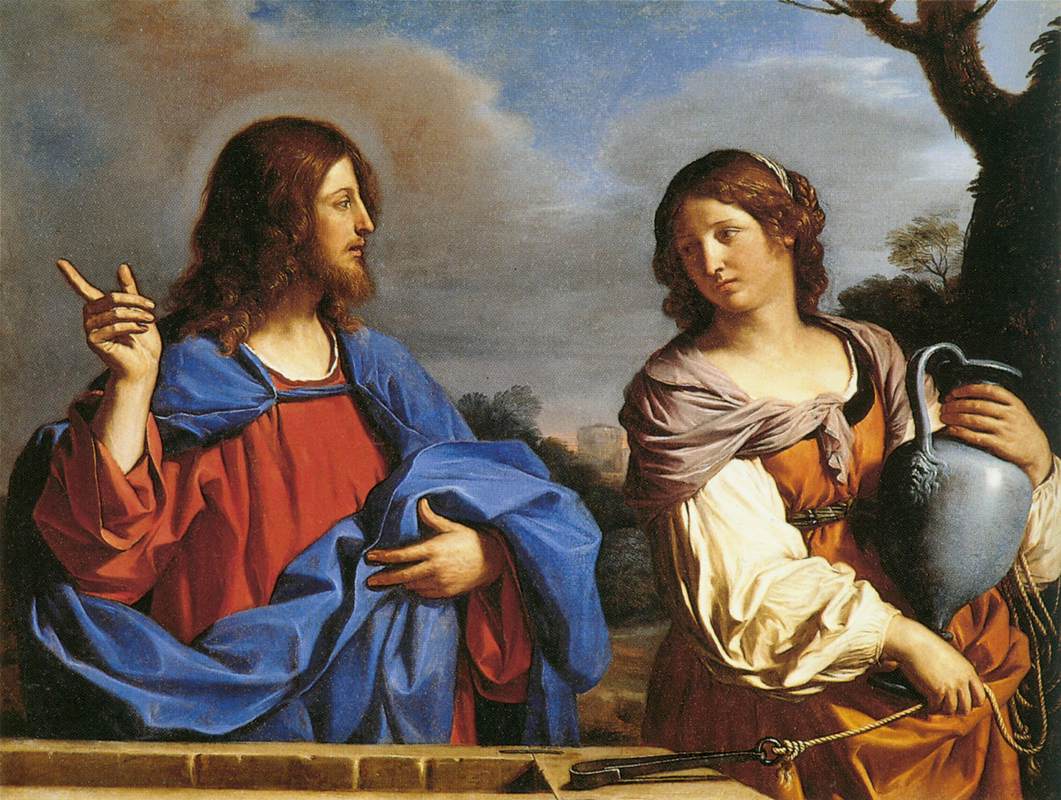
"Jesus and the Samaritan Woman at the Well" by Guercino
In preparation for worship Sunday, March 23, 2014 read John 4:5-42 and reflect on the following:
  1. Why is Jesus in Samaria?
  2. How is Jesus' humanity revealed in this passage?
  3. How is his divinity revealed?
  4. What is the woman's initial response to Jesus?
  5. What does she do as a result of her encounter with him?
The following prayer, "Sinking wells" was written by Janet Morley. Take time to read it a couple of times and consider its meaning for your life.

Sinking wells
Come to the waters
all you who are thirsty;
children who need water
free from diseases,
women who need respite
from labor and searching,
plants that need moisture
rooted near the bedrock,
find here a living spring.
O God, may we thirst
for your waters of justice,
and learn to deny no one
the water of life.

May the Lord continue to bless you on your Lenten journey.

Shalom,
Glenda

Sunday, March 9, 2014

Blogging toward Sunday

"Jesus and Nicodemus" by Providence Lithograph Company

In preparation for worship, March 16th, read John 3:1-17. Then consider:
  1. Who was Nicodemus?
  2. How did he approach Jesus?
  3. How did Jesus receive him?
Finally, meditate on the following, written by Rainer Maria Rilke in Letters to a Young Poet:
I would like to beg you...to have patience with everything that is unsolved in your heart and to try to cherish the questions themselves like closed rooms and like books written in a very strange tongue. Do not search now for the answers, which cannot be given you because you could not live them. It is a matter of living everything. Live the questions now. Perhaps you will then gradually, without noticing it, one distant day live right into the answer.

As always, I look forward to worshiping with you Sunday. Until then, my prayer for you is that your Lenten journey will bring you ever closer to the light and love of our Lord.

Shalom,
Glenda

Tuesday, March 4, 2014

Blogging toward Sunday

"The Temptation of Christ on the Mountain" via Wikimedia Commons

In preparation for worship the First Sunday in Lent, prayerfully read and meditate on Matthew 4:1-11. Afterward, take a few moments to closely examine the art provided above. Then consider the following:
  1. What strikes you as most important from the gospel reading?
  2. Who are the participants in the story, other than Jesus?
  3. What do you learn from the image above?
Finally, may you be blessed by the following Lenten prayer written by Ann Weems:

Holy is the time and holy is this place,
and there are holy things that must be said.

Let us say to one another what our souls whisper...
O Holy One, cast your tent among us;
come into our ordinary lives and bless the living!

Forty days stretch before us,
forty days of hungering after faithfulness,
forty days of trying to understand the story,
and then, Holy Week...
O God, if every week were holy...

These forty days stretch before us,
and those of us who believe,
yearn to feel Your presence,
yearn to be Your people;
and yet the days fill with ordinary things
with no time left
for seeking the holy.

Spiritual contemplation is all right
for those who have the time,
but most of us have to make a living.

Most of us have to live in the real world
where profanity splashes and blots out
anything holy.

Where, O Holy One, can we find you in this unholy mess?

How, O God, can we find the holy in the ordinary? 

I look forward to worshiping with you this Saturday, at the Celtic Service, as well as Sunday morning.
May the Lord bless you on your Lenten journey.

Shalom,
Glenda

Sunday, February 23, 2014

Blogging toward Sunday

"Transfiguration" by Giovanni Gerolamo Savoldo; via Wikimedia Commons

Sunday we celebrate the Transfiguration of Christ. In preparation, read Exodus 24:12-18 and Matthew 17:1-9. Then consider the following:
  1. Throughout the Gospel of Matthew, Jesus is portrayed as the "New Moses." How is this theme evident when you compare the two readings? 
  2. Regarding Jesus' transfiguration, what other elements of the story stand out for you?
  3. Why does Jesus instruct the disciples to keep quiet about what they have seen?
  4. What does the word "transfiguration" really mean?
May the following prayer, written by Bruce Prewer, bless you as you journey forth this week.

Baptized by the morning
Risen Lord Jesus,
as the rising sun
baptizes trees and shrubs
in rippling light,
let me be baptized
by your resurrection light.

May I
trust in you above all else,
hope in you above all other goals,
seek you in all things,
find you in every situation,
meet you among all people,
know you over everything---

And love you with adoration
beyond
beyond
beyond all telling.


Shalom,
Glenda

Wednesday, February 19, 2014

Blogging toward Sunday

Art via Google Images

In preparation for worship, read Matthew 5:38-48. In their commentary in the NRSV: Life with God Bible, Ben Witherington III and Darlene Hyatt offer these words of wisdom: 
Jesus' higher standard for his disciples is made clear--we are to perfectly manifest the love God has for all persons. This call to love extends even to our enemies. The love demanded here has nothing to do with reciprocal relationships; rather, it is a matter of giving with no thought of return. God the Father is characterized as an indiscriminate lover and blesser of both the evil and the good, giving to both the sun and the rain needed for crops and sustenance.
As you reflect on the above commentary and the reading, consider the following:
  1. How difficult is it to love someone who has mistreated you?
  2. What is your general response should you encounter that person again?
  3. How does our ability to love compare with God's? 
  4. What do you find most challenging about the Sermon on the Mount, in general?
I pray you are having a good week and look forward to worshiping with you Sunday.

Blessings,
Glenda

Monday, February 10, 2014

Blogging toward Sunday

via Google Images

Our gospel reading for Sunday, February 16th continues Jesus' Sermon on the Mount. Read through Matthew 5:21-37 at least three times using the spiritual practice of Lectio Divina. In this type of reading, the text is engaged slowly and prayerfully, taking time to sit quietly in between each reading. In the silence, listen for the word, the phrase, or the teaching the Holy Spirit might have for you at this juncture in your spiritual journey.

This passage speaks of blessings and curses, life and death, good relationships and those that are broken. Herein, does Jesus suggest we have a choice in these matters? If so, how?

Finally, consider the following, which are questions posed by Kimberly Bracken Long in her liturgical resource, Feasting on the Word; Worship Companion:
  1. Where do you find life and where do you not? 
  2. What role do your choices play?
  3. Where have you experienced broken relationships in your own life or in the church?
  4. How do Christ and the reign of heaven enable us to move beyond brokenness and live in mutual support?
As always, I look forward to worshiping with you. Until then, may your week be filled with courage, wisdom, and blessings.

Shalom,
Glenda